
Behind Every Google Search: 5 Algorithms You Should Know
When you type a question into Google, the answer appears in just a few seconds. It almost feels effortless. But behind those search results is a complex system of algorithms working together to decide which websites deserve to appear first.
Google processes billions of searches every day, and its algorithms are constantly evolving to provide users with the most relevant, trustworthy, and helpful information. For website owners, marketers, and SEO professionals, understanding these algorithms is essential because they directly influence how websites rank in search results.
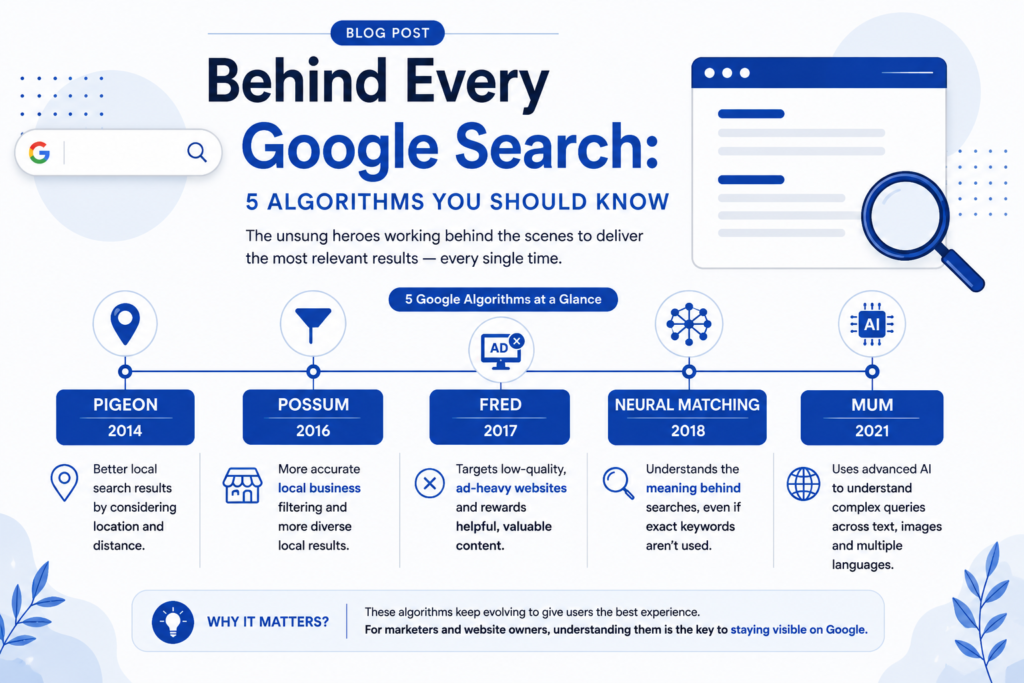
In this blog, we’ll explore five important Google algorithms Pigeon, Possum, Fred, Neural Matching, and MUM and learn how each one has shaped the way we search online.
1. Pigeon (2014): Bringing Local Businesses Closer to Customers
Before the Pigeon update, local search results were not always accurate. Businesses that were closer to a user didn’t necessarily appear higher in search results, making it difficult for people to find nearby services.
Google introduced Pigeon in 2014 to improve local search by considering factors such as the user’s location, distance, and the relevance of nearby businesses. The update also strengthened the connection between Google’s local search and its traditional ranking signals.
Example
Imagine you’re in Calicut and search for “best coffee shop near me.” Instead of showing coffee shops from another city, Google prioritizes businesses that are nearby, have relevant information, and are considered trustworthy.
Why It Matters for SEO
- Optimize your Google Business Profile.
- Keep your business name, address, and phone number consistent across the web.
- Encourage genuine customer reviews.
- Use location-specific keywords naturally in your content.
2. Possum (2016): Making Local Search More Accurate
Two years after Pigeon, Google launched Possum to further improve local search results. This update focused on filtering duplicate business listings and providing users with more diverse local results.
Possum also made search results more dependent on the searcher’s physical location. Even small changes in where a person searches from can lead to different local search results.
Example
Suppose two digital marketing agencies operate in the same building. Before Possum, Google might have shown only one of them. After the update, Google became better at filtering duplicate or similar listings while still allowing legitimate businesses to appear fairly.
Why It Matters for SEO
- Maintain accurate business information.
- Avoid creating duplicate listings.
- Optimize for your local audience instead of trying to rank everywhere.
3. Fred (2017): Rewarding Helpful Content
Google’s Fred update targeted websites that prioritized advertising and revenue over user experience. Many websites published thin, low-quality articles filled with excessive ads simply to attract clicks.
Fred was designed to reduce the visibility of these websites while rewarding pages that provide genuine value to readers.
Example
Imagine visiting a blog where advertisements cover most of the screen, making it difficult to read the content. Compare that to a website with useful, well-written information and minimal distractions. Fred encourages Google to rank the second type of website higher.
Why It Matters for SEO
- Publish original and informative content.
- Avoid excessive advertisements.
- Focus on helping readers rather than just generating clicks.
- Improve the overall user experience.
4. Neural Matching (2018): Understanding What You Really Mean
Not every search query contains the perfect keywords. Sometimes people describe what they want instead of using exact phrases. Google’s Neural Matching system helps bridge that gap.
Rather than matching only keywords, Neural Matching understands the relationship between words and concepts. This allows Google to better understand the meaning behind a search.
Example
A user searches for “why does my room feel hot even with the AC on?”
Even if a webpage doesn’t contain that exact sentence, Google can understand that the user may be looking for information about poor insulation, blocked air vents, or air conditioner maintenance.
Why It Matters for SEO
- Write naturally for people, not search engines.
- Answer common questions clearly.
- Focus on topics rather than repeating keywords.
- Create content that matches user intent.
5. MUM (Multitask Unified Model) (2021): Google's Most Advanced AI
MUM, short for Multitask Unified Model, represents one of Google’s biggest advances in artificial intelligence.
Unlike earlier algorithms, MUM can understand information from text, images, and multiple languages. It is designed to answer complex questions by connecting information from different sources instead of relying on a single webpage.
Example
Imagine someone asks:
“I’m planning a trek to Mount Fuji next year. What should I prepare if I’ve already climbed a mountain in India?”
Instead of simply displaying pages about Mount Fuji, MUM understands the context of the question and can combine information about weather, equipment, fitness, travel, and hiking experience to provide more useful results.
Why It Matters for SEO
- Create comprehensive, in-depth content.
- Use images with descriptive alt text.
- Cover topics thoroughly instead of writing short articles.
- Build expertise and trust through accurate information.
Final Thoughts
Google’s search algorithms continue to evolve with one clear goal: delivering the most helpful and relevant results to users. From improving local search with Pigeon and Possum, to promoting high-quality content through Fred, and advancing search intelligence with Neural Matching and MUM, each update has made search more accurate and user-focused.
For anyone interested in digital marketing or SEO, these algorithms highlight an important lesson: successful websites don’t rely on shortcuts or keyword stuffing. Instead, they focus on creating valuable content, providing a great user experience, and building trust with their audience.